Monday Edition · Mon 19 Oct 2026
China Grows 4.5% on an Export and High-Tech Boom While Consumers Stay Absent
China's economy expanded 4.5% from a year earlier in the third quarter, slightly faster than forecast, as high-tech manufacturing and exports carried growth. Retail sales rose just 1.1% in September and investment kept shrinking, leaving a recovery that analysts describe as unbalanced and a yuan near its strongest level in years.
Not investment advice: this article is for information only.
Chanan Zevin - Chief Editor and Head of Desks
Published
A slightly stronger quarter
China's gross domestic product grew 4.5% year on year in the July to September quarter, the National Bureau of Statistics said on Monday, 19 October. Economists had expected 4.4%, according to Investing.com. Growth accelerated from 4.3% in the second quarter, which had been the slowest pace in more than three years, AP reported. On a quarter-on-quarter basis, the economy grew 1.2%, up from 0.9%. Chart 1 shows the quarterly path this year, from 5.0% in the first quarter to 4.3% and then 4.5%.
Nine months of output
For the first three quarters combined, GDP reached 107.1 trillion yuan, up 4.6% at constant prices, the statistics bureau said. The services sector grew 5.2%, industry 3.8% and agriculture 3.7%. Third-quarter output alone was 37.5 trillion yuan. The year-to-date figure leaves China close to its official annual growth target, AP reported, although the bureau did not restate the target in its release.
Factories picked up in September
Industrial production rose 5.5% year on year in September, beating forecasts of 5.4% and accelerating from 5.2% in August, according to Investing.com. On a month-on-month basis output rose 0.61%, the bureau said. The official manufacturing purchasing managers' index rose to 50.1 in September from 49.8 in August, moving back above the 50 line that separates expansion from contraction. For the first nine months, industrial value added grew 5.3%.
High-tech manufacturing leads
The strongest growth came from advanced manufacturing. Value added in high-tech manufacturing rose 14.3% in the first nine months, and equipment manufacturing rose 10.2%, the bureau said. Both grew far faster than industry as a whole. Production of 3D printing devices rose 62.5%, lithium-ion batteries 39.5% and industrial robots 29.1%. These are the sectors most closely tied to automation, electrification and the global spending boom on AI infrastructure.
Consumers remain the weak link
Household spending told a different story. Retail sales of consumer goods rose 1.1% year on year in September, more than the 0.5% to 0.6% expected and up from 0.4% in August, according to Investing.com and Gelonghui. For the first nine months, goods retail sales rose just 1.1%. Sales of goods and services combined grew 2.6%, with services up 5.0% and goods up 1.0%. A gap of that size between output and spending is the core of the imbalance analysts describe.
Investment is still shrinking
Fixed-asset investment fell 7.2% year on year from January to September, according to Trading Economics, citing official data. Property investment fell 20.6%, and infrastructure investment fell 4.2%. Falling investment in buildings and infrastructure is a drag that exports and factory output have had to offset. The decline in property investment reflects a housing slump that has lasted several years and continues to weigh on household confidence and local government finances.
Exports power the recovery
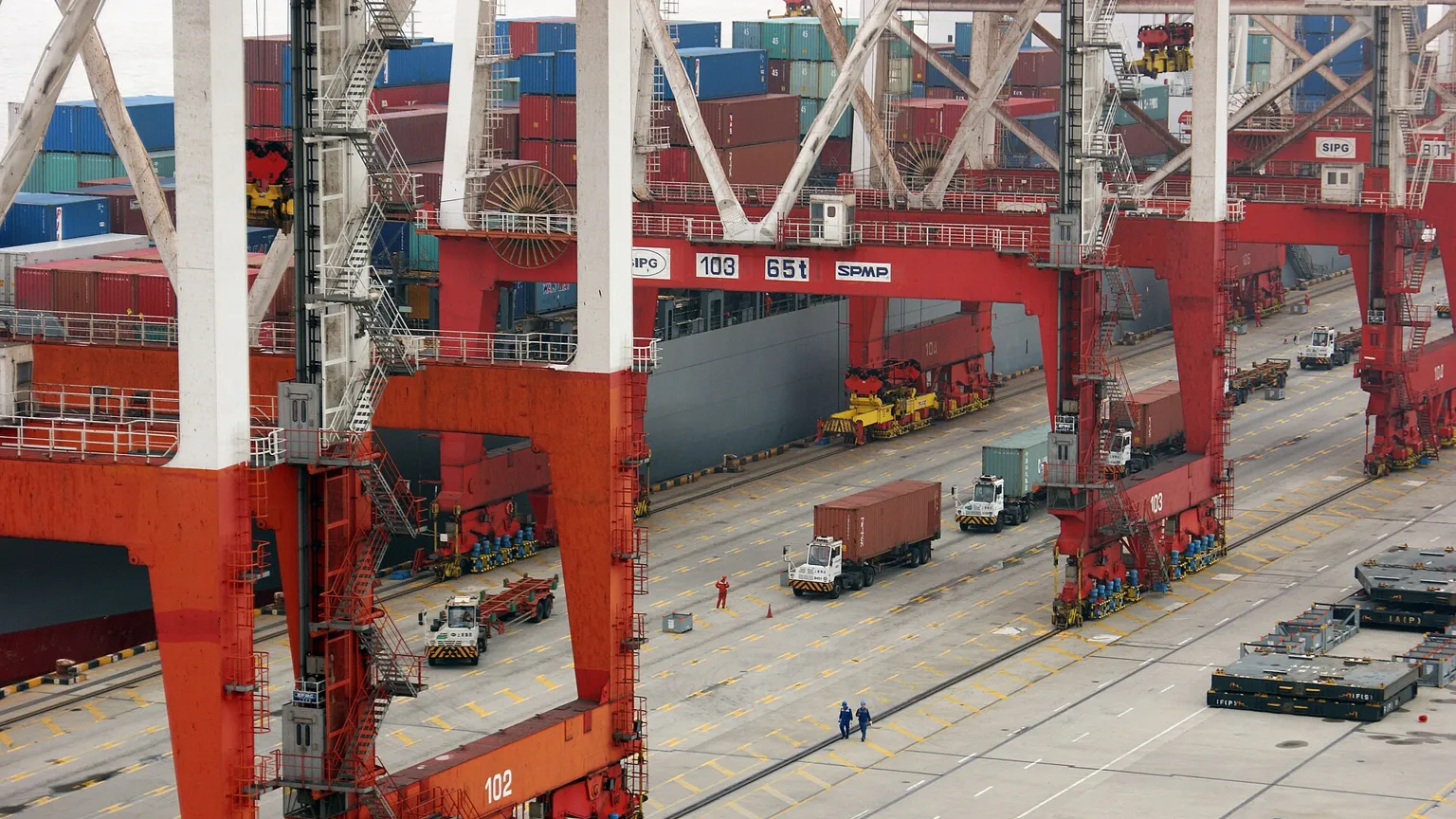
Trade has been the main engine. China's trade surplus reached $938 billion in the first nine months of the year, AP reported in separate coverage of trade data. AP said Monday's growth figures were fuelled by robust exports as trading partners seek to balance their deficits with China. A growing surplus supports GDP but increases friction with partners who see Chinese goods displacing their own industries.
Europe's side of the ledger
Europe is one of the places where that friction shows. The headline brief for this edition said China's trade surplus with Germany and France had each risen by more than 200% year on year. The Journal could not confirm that figure. Available reporting on June data showed the surplus with Germany more than doubling while the surplus with France fell. The direction for Germany is consistent with the brief, but the France figure is not, so this article does not use the 200% claim.
The yuan near multi-year highs
The yuan has strengthened alongside exports. Bloomberg and Caixin reported on 18 September that the currency had climbed to its strongest level since 2022, passing 6.7 per dollar. On Monday the yuan edged higher again, with the dollar down about 0.1% against the onshore currency, Investing.com reported. A stronger yuan makes imports cheaper for Chinese households but erodes the price advantage of Chinese exports, which could slow the trade engine over time.
What a strong yuan means for markets
For currency markets, the combination of a large surplus and a firm yuan is unusual. Large surpluses usually mean steady demand for the currency from exporters converting earnings. Official fixings from the People's Bank of China have supported the move, according to Bloomberg. Traders will watch whether the central bank allows further appreciation or leans against it to protect exporters. The answer affects other Asian currencies that compete with Chinese goods.
Markets shrugged at the data
Chinese stocks did not rally on the stronger growth figures. The CSI 300 slipped 0.2% and the Shanghai Composite lost 0.3% after the release, Investing.com reported. The broker XTB described the Shanghai market as stable following the better-than-expected reading. The muted reaction suggests that investors had expected decent growth and remain focused on weak consumption and the property market.
Why analysts call it unbalanced
The pattern of the data explains the description. Output and exports are growing at a healthy pace, while household spending and investment lag. When production outruns domestic demand, the surplus has to be sold abroad, which pushes up the trade surplus and invites trade defences from partners. Economists have long urged Beijing to shift growth towards consumption. Monday's figures show that shift has not yet happened, even as headline growth improved. Until consumption picks up, growth will depend on how much the rest of the world is willing to buy.
The policy question
The statistics bureau said macro policy adjustment had been stepped up this year. Officials have introduced measures to support consumption, but the retail figures suggest their effect is limited so far. A larger stimulus aimed at households would support consumption but add to government debt. Continued reliance on exports would keep growth near target but deepen tensions with Europe and the United States. Beijing's choice will shape global trade flows in 2027.
Profits and prices
There are signs of improvement in company finances. Profits at large industrial enterprises rose 15.7% in the first eight months of the year, the bureau said. Higher profits give companies room to invest and hire, which could eventually support consumption. However, the investment figures show that companies are not yet expanding capacity at home on a broad basis, outside the high-tech sectors.
The AI link
The bureau's data offers a partial view of how the AI buildout is showing up in China's economy. Output of industrial robots, batteries and advanced equipment is rising fast, and these goods feed both domestic factories and overseas customers building data centres and power systems. The bureau does not break out AI-related exports directly, so any claim that AI alone is driving growth goes beyond what the data shows. The more careful conclusion is that high-tech manufacturing is the fastest-growing part of the economy.
Online sales keep growing
Online retail continued to grow faster than the overall consumer market. Online retail sales of goods and services reached 15.1 trillion yuan in the first nine months, up 4.4% year on year, the bureau said. Online goods sales rose 3.8%, and online services rose 5.3%. Sales of communication equipment at larger retailers rose 18.1%, and grain, oil and food sales rose 6.8%. These figures show that spending is concentrated in essentials and in digital devices, rather than in big-ticket discretionary items such as cars or housing-related goods.
Ownership and regions
The recovery was uneven across types of company. Value added at share-holding enterprises rose 5.8% in the first nine months, while state-controlled enterprises grew 3.8%, private enterprises 4.3% and foreign-funded enterprises 3.2%, the bureau said. Urban retail sales grew 0.9%, while rural sales grew 2.3%. The weaker performance of foreign-funded firms is consistent with reports of companies diversifying supply chains away from China, although the data alone cannot show the cause.
What to watch next
Three releases will test the picture. October trade data will show whether exports keep their pace as the yuan strengthens. Monthly retail sales will show whether September's improvement was a turning point or a blip. And any new consumption measures from Beijing ahead of year-end planning meetings will show whether policymakers are ready to change the balance of growth.
Journalistic Scoop
Services, not goods, are where Chinese consumers are actually spending. The headline retail figure of 1.1% understates one shift inside the data. The statistics bureau's broader measure shows retail sales of services rising 5.0% in the first nine months, against 1.0% for goods. Communication and information services, travel and leisure grew fastest, the bureau said. Online services retail grew 5.3%.
That split suggests Chinese households are not absent altogether but are moving spending from goods to experiences and digital services, which the most quoted retail number does not capture. For companies selling physical consumer goods into China, the picture is as weak as the headline suggests. For services providers, it is better. Policymakers looking for a consumption engine may find it in services rather than in goods subsidies.
Sources: National Bureau of Statistics of China · Investing.com
Sources
- National Bureau of Statistics of China, National Economy was Generally Stable in the First Three Quarters, 19 Oct 2026 · stats.gov.cn
- Investing.com, China industrial output, retail sales beat forecasts in September, 19 Oct 2026 · investing.com
- AP News, China's economy grew 4.5% in July-September quarter, 19 Oct 2026 · apnews.com
- Trading Economics, China Fixed Investment Drops 7.2% in Jan-Sep, 19 Oct 2026 · tradingeconomics.com
- Caixin Global, Yuan Surges Past 6.7 per Dollar to Three-Year High, 18 Sep 2026 · caixinglobal.com
- AP News, China's trade surplus hits $938 billion for first 9 months · apnews.com
Related
- Stock Futures Rebound After the Chip Rout, but This Week's Earnings Will Decide the AI Trade
- France Counts 550,000 Marchers and Nearly 2,400 Arrests as the Budget Faces Its First Vote on Tuesday
- Samsung Will Use TSMC's 3nm Process for Nvidia's Custom HBM Base Dies, Breaking With Its All-In-House Model