Thursday Edition · Thu 22 Oct 2026
Houthi Drones Kill Three at Saudi Oil Field and Dammam Airport as US Orders Staff Out of the Kingdom
Drone attacks on Aramco's Shaybah field and King Fahd International Airport killed three people on Wednesday, and Washington ordered non-emergency diplomats to leave Saudi Arabia. Iran, meanwhile, told mediators it will not talk to the United States until its conditions are met.
Chanan Zevin - Chief Editor and Head of Desks
Published
Two strikes in one day
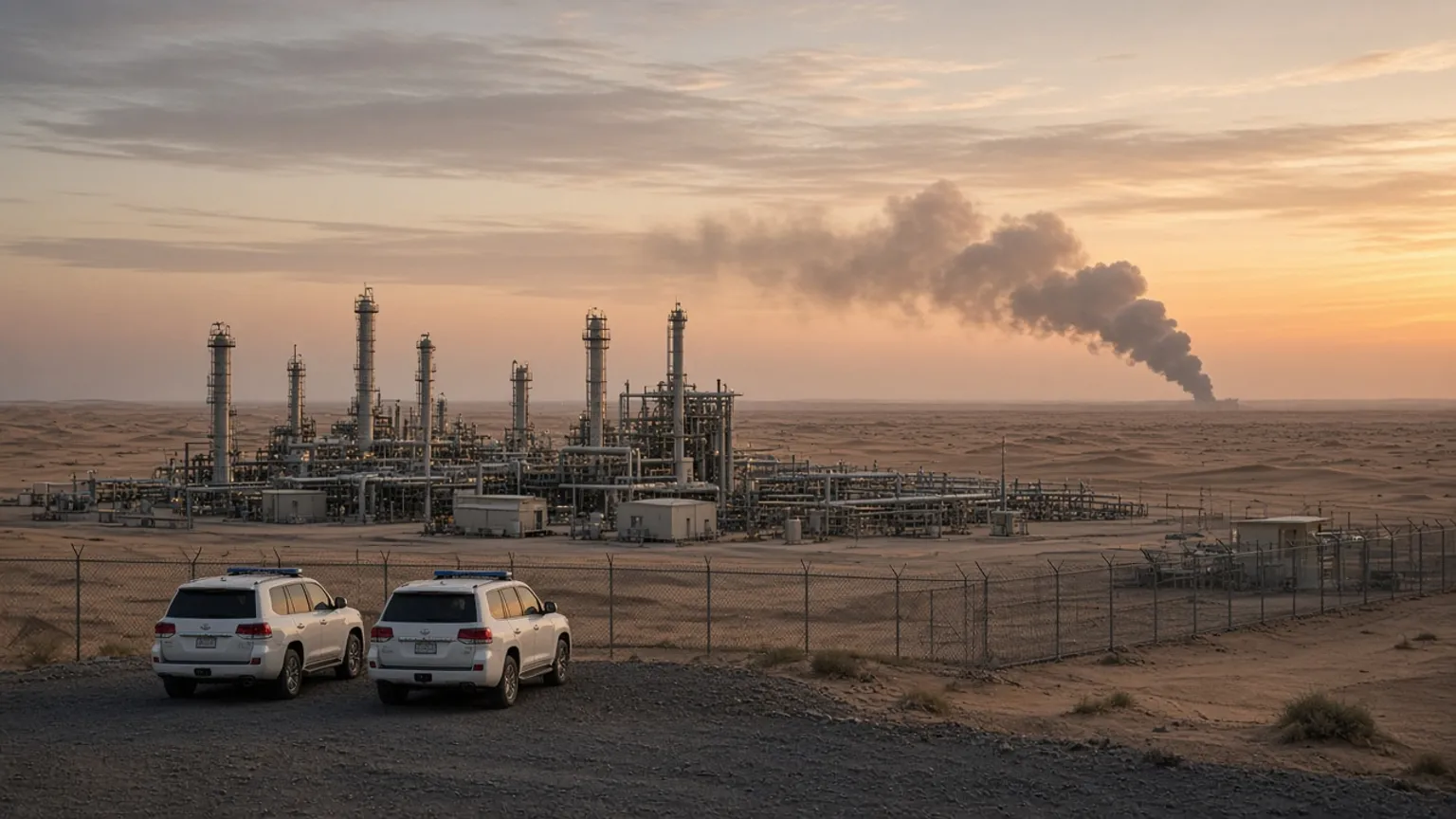
Three people were killed and eight injured in two drone attacks in Saudi Arabia's Eastern Province on Wednesday, 21 October, according to Bloomberg reporting published by The Straits Times. A drone aimed at a processing facility at Aramco's Shaybah oil field set a vehicle on fire outside the target's perimeter and killed two workers, one from Nepal and one from the Philippines. Later the same day, one person was killed and eight were hurt in an attack on King Fahd International Airport in Dammam, the General Authority of Civil Aviation said. The Saudi energy ministry said operations at Shaybah, a field with capacity of about one million barrels a day, were not affected. Damage at the airport was still being assessed when the reports were published.
Who claimed what
Yemen's Houthi movement has been attacking Saudi Arabia for months and did not immediately claim the Shaybah and Dammam strikes, according to the Bloomberg report. Later on Thursday, the group said it had attacked Saudi oil facilities and airports, The Hindu and Yahoo News reported, listing the Defence Ministry in Riyadh, an Aramco site in Yanbu, Abha airport and Dammam airport among its targets. Those wider claims have not been independently confirmed. The Saudi-led coalition in Yemen said it intercepted multiple drones over the Eastern Province on Wednesday. The gap between claims and confirmed damage is normal in this conflict, and the Journal reports only what officials or several outlets have stated.
Washington pulls back staff
The US State Department issued an ordered departure on 21 October for non-emergency government employees and their families in Saudi Arabia, spokesman Tommy Pigott said on X. Reuters reported that the department also plans to withdraw family members from several other US missions in the region. The US embassy in Riyadh had already urged extreme caution when using Saudi airports. An ordered departure is a formal step that goes beyond a travel advisory. It signals that Washington judges the risk to its own people in the kingdom to be higher than at any point since the Houthi campaign began.
A campaign that has grown
The Houthis declared a blockade of Saudi ports in July and began firing at the kingdom almost daily in September, according to the same Bloomberg account. They have repeatedly targeted Saudi airports and have killed at least 17 people in Riyadh. A week ago they struck Aramco's headquarters in Dhahran. The campaign has already forced the postponement of Saudi Arabia's flagship Future Investment Initiative conference to 2027. In early October the Saudi coalition announced a large operation to retake Houthi-held territory, and the fighting has intensified since then.
The Red Sea dimension
The Houthis have also pushed south from their stronghold in north-west Yemen towards the Bab el-Mandeb Strait, according to Bloomberg. That narrow passage links the Red Sea to the Gulf of Aden and carries tankers and container ships moving between Asia and Europe through the Suez Canal. Control of territory near the strait would give the group more ways to threaten shipping. For Saudi Arabia, which ships part of its crude from Red Sea ports such as Yanbu, the southern front matters as much as the drone attacks on the Eastern Province.
Tehran's hard line
The strikes came as Iran hardened its position in indirect talks with Washington. On Tuesday, Iranian officials told Pakistan's army chief, Field Marshal Asim Munir, that there would be no talks with the United States until Tehran's demands were met, Reuters reported. Parliament speaker Mohammad Bagher Ghalibaf said Washington could not regain Iran's trust without meeting seven conditions set last month for reopening the Strait of Hormuz. These include ending the US blockade of Iranian ports, lifting sanctions on oil exports and ending hostilities on all regional fronts. Security chief Mohsen Rezaei said all enriched nuclear material would stay in Iran.
Mediators still talking
Qatar's foreign ministry said on Tuesday that messages between Washington and Tehran were still being exchanged through mediation channels, CGTN reported. Foreign Minister Abbas Araghchi told Iraqi state television that indirect talks continue through Pakistan and Qatar, The National reported. He also said the Strait of Hormuz will not be fully open to everyone until an agreement is reached. In a Financial Times opinion article, Araghchi accused the White House of threatening violence while showing no willingness to reach an understanding. Diplomacy therefore continues, but both sides are publicly describing it as stuck.
Plans for renewed strikes
The New York Times reported, citing unnamed US officials, that the US and Israeli militaries have drawn up specific plans for renewed strikes on Iran after next month's US midterm elections, CNBC reported. The officials described planning for a short but intensive operation. President Donald Trump told reporters something would happen "fairly soon" on Iran. The National reported that Washington has sent a third aircraft carrier to the region. None of this means a decision to strike has been made. It does mean the military option is being prepared in detail while talks stall.
Why the Gulf is exposed
The pattern of the past weeks links several fronts. Iran limits passage through Hormuz, the Houthis strike Saudi oil and airports, and Iran's Revolutionary Guards say they hit vessels in the northern Gulf. Each front raises costs for Gulf producers and for shipping. Saudi Arabia has so far said its oil output is unaffected, and Morgan Stanley estimated Middle East crude exports at about 17 million barrels a day last week, Reuters reported. The risk is not one large outage. It is a steady accumulation of smaller hits that push up insurance, freight and security costs.
The market reaction
Oil prices rose sharply on Thursday. Brent crude climbed to $112.68 a barrel at one point, its highest since 18 May, before trading near $112, Reuters reported. Analyst Tamas Varga of PVM Oil said no de-escalation is expected before the US midterm elections. The Journal's commodities desk covers the price move in detail in today's edition. For the geopolitical picture, the key point is that traders now treat a Gulf escalation as a central scenario rather than a tail risk.
Civilians in the line of fire
The victims of Wednesday's attacks were not soldiers. The two people killed at Shaybah were foreign workers from Nepal and the Philippines, and the casualties at Dammam were at a civilian airport, according to the Saudi authorities quoted by Bloomberg. Saudi Arabia employs millions of foreign workers, many of them in the energy sector and at transport hubs. Attacks on these sites therefore carry a human and diplomatic cost for countries far from the conflict. Governments in South and South-East Asia have every reason to watch the security of their citizens in the Eastern Province closely.
Egypt's limits
The Times of Israel reported that Egyptian President Abdel Fattah al-Sissi said Egypt's military support for the kingdom will not include strikes in Yemen. The statement shows the limits of Arab backing for Riyadh. Neighbours are willing to express solidarity and offer defensive help, but few want to be drawn into a direct war with the Houthis. That leaves Saudi Arabia relying mainly on its own forces, its coalition partners in Yemen and the United States, which is itself now reducing its civilian presence in the kingdom.
Israel's election backdrop
The regional escalation coincides with Israel's general election on 27 October. The Times of Israel has reported that Prime Minister Benjamin Netanyahu pushed earlier this month for an attack on Iran that President Trump opposed, and The National reported a similar account. How the next Israeli government approaches Iran will shape the planning described by US officials. The Journal's politics desk covers the election arithmetic in today's edition.
What to watch
Three questions will shape the coming days. The first is whether Saudi Arabia responds to the latest strikes with a wider operation in Yemen. The second is whether Iran's mediators, Pakistan and Qatar, can produce any proposal that both sides accept before 3 November. The third is whether Washington's evacuation of staff from Saudi Arabia is followed by similar steps elsewhere in the Gulf. The Journal will report confirmed facts and will not treat claims by any party as established until they are corroborated.

Sources
- Bloomberg via The Straits Times, 3 killed, 8 injured in attacks on Aramco oil field, Saudi airport, 22 Oct 2026 · straitstimes.com
- Al Jazeera, Attack on Saudi Arabia's King Fahd airport, 22 Oct 2026 · aljazeera.com
- The Hindu, Houthis say they attacked Saudi Defence Ministry, Aramco in Yanbu and Dammam airport, 22 Oct 2026 · thehindu.com
- Reuters via Arab News, Iran to Pakistan's army chief: no talks with Washington before our demands are met, 21 Oct 2026 · arabnews.com
- CGTN, Qatar says US-Iran talks continue, 21 Oct 2026 · news.cgtn.com
- The National, Iran clings to demands even as threat of renewed US-Israel attacks grows, 21 Oct 2026 · thenationalnews.com
- CNBC, Brent crude tops $111 after Trump hints at action on Iran, 22 Oct 2026 · cnbc.com
- Reuters via Yahoo Finance, Brent hits five-month high, 22 Oct 2026 · finance.yahoo.com
- The Times of Israel, US orders embassy staff, families to leave Saudi Arabia; Netanyahu planned attack on Iran but Trump opposed it, 22 Oct 2026 · timesofisrael.com
Related
- Brent Hits a Five-Month High Near $113 as Houthi Strikes and Iran War Plans Outweigh Strong Gulf Exports
- Final Polls Before Israel's 27 October Election Show a 51-51 Deadlock, With Arab Parties and the Reservists Holding the Balance
- Airports and Oil Fields Are Not Bargaining Chips: The Gulf Needs a Line Around Civilian Infrastructure Before the Next War Begins