Musk Confirms TSMC Talks on Terafab, Clouding Intel's Foundry Bet
Elon Musk's confirmation of talks with TSMC about joining Terafab raises questions about Intel's foundry strategy and valuation, as investors weigh the implications for its 14A process and customer exclusivity.
Chanan Zevin — Chief Editor and Head of Desks
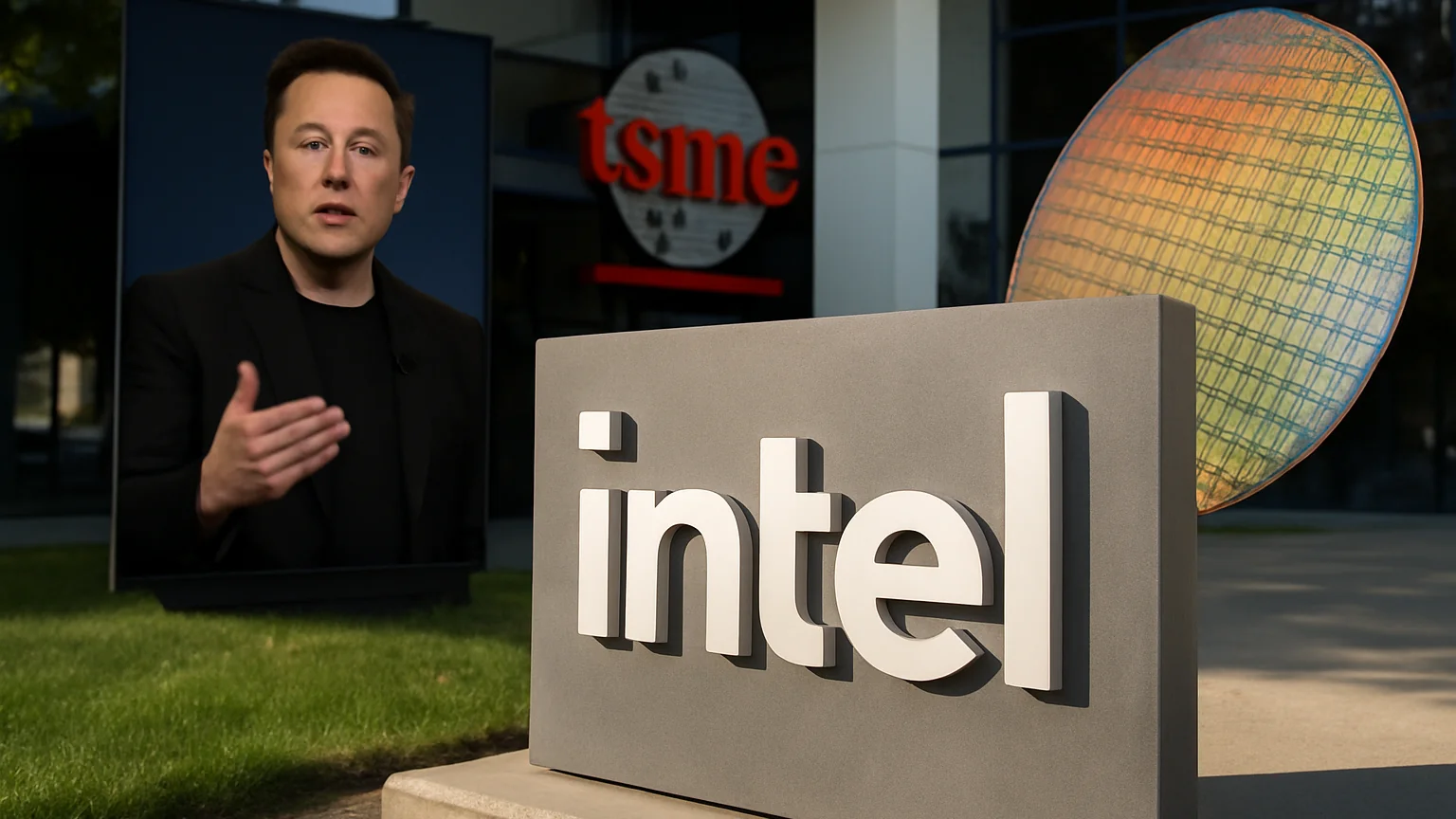
Musk's TSMC Comments Stir Intel's Foundry Ambitions
Intel shares declined about 2% on Monday after Elon Musk confirmed that TSMC could participate in Terafab, the Texas chip venture where Intel's 14A process is currently the only named technology. Musk described the situation as "just discussions," but acknowledged that "something may come of it" regarding TSMC's potential involvement. This development has drawn significant attention from investors and industry observers. [S1]
Terafab, a joint venture between Tesla and SpaceX, aims to manufacture chips for Musk's companies in Grimes County, Texas. With $16.8 billion committed to the first phase and up to $119 billion across all phases, the project's scale is substantial. Output from Terafab is reserved for Tesla, SpaceX, and xAI, making it a high-profile opportunity for any foundry participant. [S1]
Intel was the first chipmaker to back Terafab, joining in April, and its next-generation 14A process is the facility's only named process technology to date. The possibility of TSMC joining the venture introduces uncertainty about Intel's role and the exclusivity of its technology showcase. [S1]
Market Reaction and Investor Sentiment
The news of TSMC's potential involvement in Terafab had an immediate impact on Intel's stock, which fell about 2% on Monday. In contrast, the rest of the chip sector remained relatively stable, with AMD slipping less than 1% and Nvidia edging up slightly. The market's reaction underscores the importance of Terafab to Intel's foundry narrative. [S1]
Intel's stock has experienced significant gains over the past year, rising more than 200%. On Mad Money, Jim Cramer recently credited CEO Lip-Bu Tan with revitalizing the company. However, the prospect of TSMC sharing the Terafab spotlight has introduced new doubts about the sustainability of Intel's momentum. [S1]
TSMC's Taiwan-listed shares responded positively, closing up 3% on Monday. This divergence in stock performance highlights the perceived advantage TSMC could gain if it secures a role in Terafab, while raising questions about the implications for Intel's foundry ambitions. [S1]
Implications for Intel's 14A Process and Foundry Valuation
Terafab has been positioned as Intel's showcase for its foundry business, with the 14A process as the flagship technology. The potential entry of TSMC, the world's largest contract chipmaker, would dilute Intel's exclusivity and diminish the project's value as a proof point for its foundry capabilities. [S1]
Intel's foundry business has struggled to attract significant outside customers, generating just $293 million in revenue from external clients in the second quarter. The bulk of its $5.8 billion in foundry revenue came from internal sources, and the business still posted a $2.1 billion loss. [S1]
The market has priced Intel's stock at about 71 times forward earnings, a figure that reflects high expectations for its foundry wins, including marquee customers like Terafab. If TSMC becomes a co-participant, the justification for this premium valuation could weaken, especially if Intel is no longer seen as the exclusive technology provider. [S1]
Strategic Uncertainties and Competitive Dynamics
The reported setup under consideration would have TSMC own and operate a new facility, with Terafab as an anchor customer. This arrangement could allow both TSMC and Intel to maintain roles in the project, but the specifics remain unclear. Musk's comments emphasize that talks are ongoing and no formal agreement has been reached. [S1]
Intel's position as the only named process provider at Terafab has been a central part of its foundry comeback narrative. Losing this exclusivity to TSMC would represent a significant strategic setback, as Barron's characterized it, potentially undermining investor confidence in Intel's ability to compete with established foundry leaders. [S1]
Analysts have noted that much of Intel's current valuation is predicated on the expectation of securing high-profile foundry customers. The risk is that if TSMC shares or overtakes Intel's role at Terafab, the market may reassess the multiple it is willing to pay for Intel's future earnings, especially given the company's recent struggles in its core chip business. [S1]
Looking Ahead: Key Milestones and Risks
The immediate focus for investors will be whether TSMC signs a formal deal with Terafab and the release of Intel's 14A design kit, which is due in October. These milestones will help clarify the competitive landscape and the extent of Intel's involvement in the project. [S1]
Despite the current uncertainty, consensus estimates project a significant sales recovery for Intel, with revenue expected to climb to $82.6 billion by 2028, representing about 56% growth after three flat years. However, the sources do not specify how a TSMC role at Terafab would affect these projections. [S1]
Ultimately, the risk for Intel lies in the potential erosion of its foundry valuation if it cannot secure exclusive or leading roles in high-profile projects like Terafab. While nothing is signed yet, the market's reaction suggests that investors are closely watching for further developments that could reshape the competitive dynamics in advanced chip manufacturing. [S1]