Mistral Previews 1-Trillion-Parameter Large 4 Model, Weights Due Later
Mistral has launched a public preview of its Large 4 model, a 1.05-trillion-parameter multimodal AI system, with open weights set for release at the end of October. The move positions Europe at the forefront of open AI d
Chanan Zevin - Chief Editor and Head of Desks
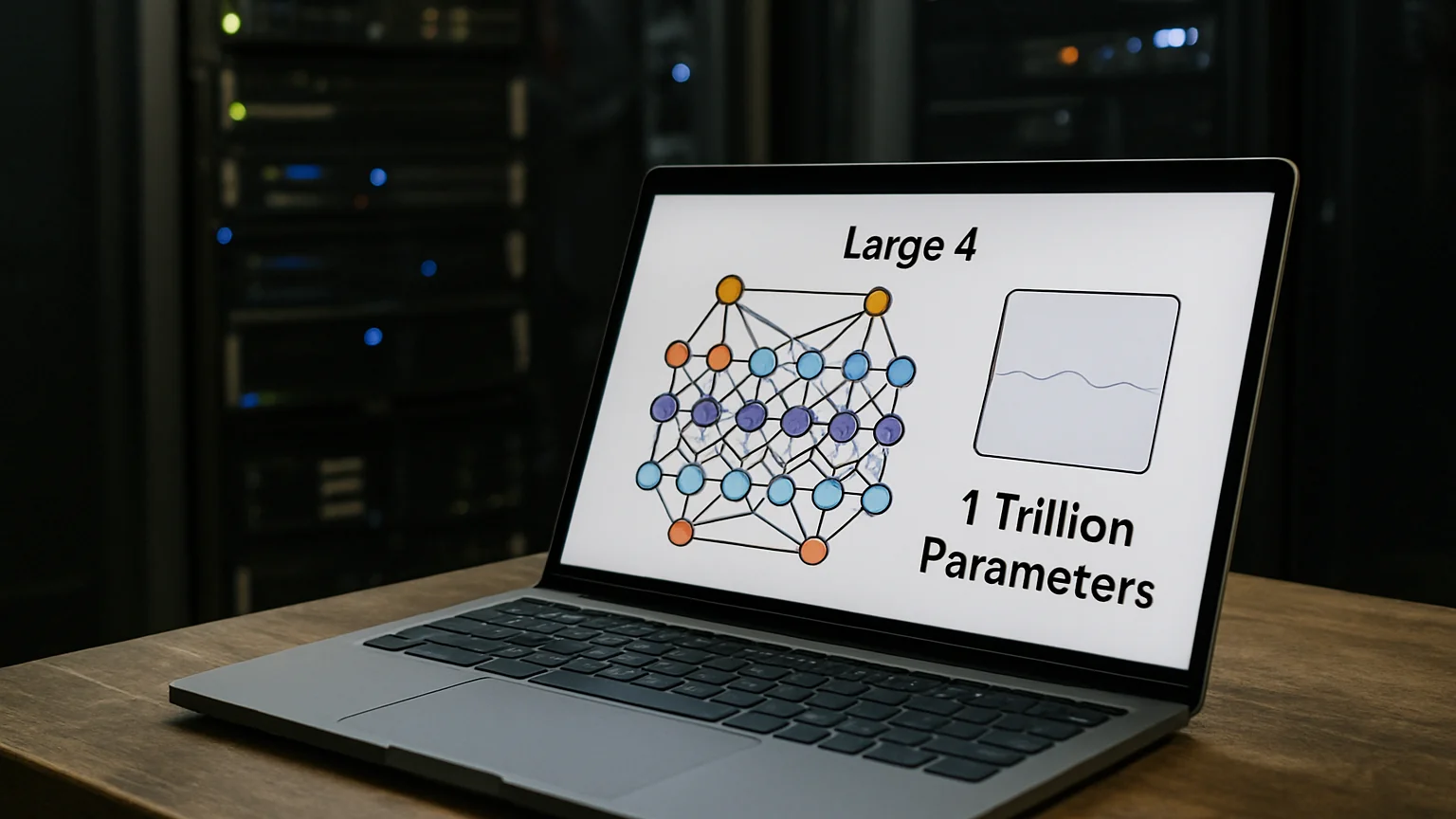
Mistral Large 4: Preview and Capabilities
Mistral has introduced a public preview of its Large 4 model, also known as ML4, which is accessible via the company's API. The model is described as natively multimodal and features a mixture-of-experts architecture, allowing it to process both text and images. This preview is currently available to developers and organizations through Mistral Studio, with the company highlighting its commitment to open-weight performance. [S1]
ML4 is Mistral’s largest and most capable model to date, boasting 1.05 trillion total parameters and 52 billion active parameters. The model also includes a 1.6 billion parameter vision encoder, supporting advanced image understanding tasks. Mistral emphasizes that the model continues to improve as it undergoes further refinement and testing, with ongoing reinforcement learning and real-world evaluation. [S2]
The model demonstrates strong results across a range of benchmarks. For example, on DeepSWE, an agentic coding test, Large 4 scored 62%, outperforming competitors such as Zhipu’s GLM-5.3 and DeepSeek-V4-Pro. In finance and legal domains, it achieved 67% on FinWorkBench and 15% on Harvey’s Legal Agent benchmark, respectively. These results indicate competitive performance with leading open-source and closed models. [S3]
Open Weights and Release Timeline
While the preview API is available immediately, Mistral has committed to releasing the model’s weights by the end of October. This will enable organizations to download and run the model on their own infrastructure, providing a level of autonomy and control not possible with closed models. The company has stated that further details on architecture and benchmarks will be shared before the weights are released. [S1]
During the interim period, Mistral is conducting extensive real-world testing with cybersecurity leaders, vetted partners, and government agencies. These groups are receiving access to a version of the model with fewer restrictions and expanded cyber capabilities, allowing for comprehensive red-teaming and evaluation in practical settings. [S3]
The sources specify that the weights will be made available on October 27. Until then, the company continues to refine the model and gather feedback from enterprise users. Mistral has indicated that the current benchmark results are preliminary and may change before the final release. [S3]
Technical Foundation and European Infrastructure
ML4 was trained from scratch on approximately 4,000 NVIDIA Grace Blackwell GPUs in Mistral’s European datacenters, consuming about 10 megawatts of power over two months. The infrastructure supporting both training and preview deployment is fully operated by Mistral in Europe, reflecting a significant investment in local AI capabilities. [S3]
A notable aspect of ML4’s development is its emphasis on AI sovereignty. The model was built to be deployed independently of other digital service providers and under European law, ensuring compliance with regional data protection requirements. This approach is intended to address concerns about reliance on foreign providers and potential disruptions to access. [S1]
The training data for ML4 was multilingual, spanning more than 160 languages, including every official language of the European Union. This broad linguistic coverage is designed to make the model applicable across diverse industries and geographies, supporting use cases in finance, engineering, manufacturing, and public sector applications. [S1]
Cybersecurity and Autonomy in AI
Cybersecurity is a central focus for ML4, with the model achieving top-tier results on independent evaluations such as the Artificial Analysis Cyber Index. It scored 82% on a test requiring reproduction and patching of real software vulnerabilities, and 93% on Cybench, a set of security competition challenges. These scores are among the highest for open-weight models. [S1]
Mistral highlights that closed models from American labs often refuse to perform certain security tasks due to provider-level restrictions, whereas ML4’s open weights and self-deployment capabilities allow organizations to conduct advanced security work under their own policies. This autonomy is particularly valued by banks, governments, and security teams who require uninterrupted and unrestricted access. [S3]
The company argues that open models like ML4 are essential for defending against threat actors who exploit closed models for offensive cyber activities. By enabling organizations to run the model on private cloud or on-premise infrastructure, Mistral aims to provide both capability and auditability for critical security operations. [S1]
Europe’s Position in Open AI Models
Mistral positions Large 4 as the most powerful open-weight AI system developed outside China, challenging the narrative that Europe cannot compete in advanced AI. The company’s leadership emphasizes the importance of technological sovereignty and transparency in model development and deployment. [S3]
Customers can choose to run ML4 on their own servers or access it via Mistral’s API in a region of their choice, including a European region where data is protected by EU law. This flexibility is intended to meet the needs of enterprises and governments seeking control over their AI infrastructure and data. [S3]
The release of ML4 is supported by a €3 billion funding round, enabling continued investment in computing power and research. Mistral already collaborates with over 125 major businesses, and the company plans to use Large 4 as the foundation for a new generation of specialized models. The sources do not specify further details on Europe’s competitive position beyond these points. [S3]